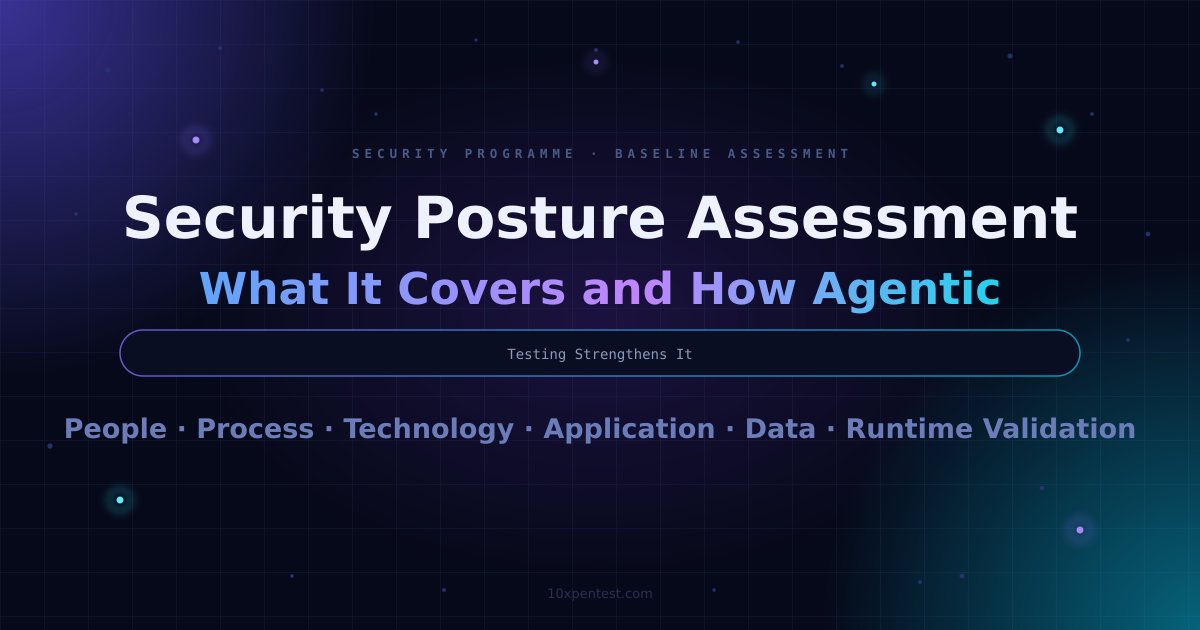
Security posture is the aggregate of your organisation's security controls, practices, and readiness: a snapshot of how well you are prepared to prevent, detect, and respond to threats at a given point in time. A security posture assessment is the structured exercise of measuring that snapshot: what controls are in place, how well they are functioning, and where the gaps are.
Most organisations commission a posture assessment when they need a baseline: before a major compliance project, before engaging a board or investor on security maturity, before deciding where to invest the next security budget cycle, or after a significant infrastructure change that may have introduced new exposure. The assessment answers "where do we stand?" before committing to a programme that addresses the answer.
This post maps what a comprehensive security posture assessment covers across five layers, what each layer's assessment produces and its inherent limitations, and where agentic testing strengthens the two layers that static review cannot fully validate.
What "security posture" actually means
Security posture is not a single metric. It is a composite measurement across multiple dimensions: policy completeness, control implementation, technical configuration, and operational effectiveness. A high posture in one dimension and a low posture in another produces an overall picture that is more useful than any single score.
Vendors (particularly those selling security ratings, CSPM platforms, and ASPM tools) frequently use "security posture" to mean the specific dimension their tool measures. A CSPM platform's "security posture score" reflects cloud infrastructure configuration; it says nothing about application security or employee security awareness. An understanding of what a complete posture assessment covers is the prerequisite for evaluating what any particular tool or service is actually measuring.
The five assessment layers
A comprehensive security posture assessment covers five layers. Each uses different methodology and produces different evidence.
Layer 1: People and security culture
What it covers: Security awareness and training maturity. Access management practices: how rigorously joiner/mover/leaver processes are followed, how access requests are approved, how access reviews are conducted. Security incident reporting culture: whether employees report suspicious activity or ignore it.
Assessment methodology: Staff interviews, training record review, phishing simulation results, access review documentation inspection, and security culture surveys.
What it produces: A qualitative assessment of security awareness maturity and access management practice quality. This layer identifies whether people are the strongest or weakest link in the security programme: whether training coverage is complete, whether security awareness is embedded in culture or treated as a compliance checkbox, whether the access management lifecycle has systematic gaps.
Layer limitation: People assessment is based on documentation and interview evidence. It identifies whether security behaviours are practiced on average, not whether specific individuals represent security risks. Social engineering testing (phishing simulation, physical security testing) can validate the people layer with empirical evidence rather than attestation.
Layer 2: Process and policy
What it covers: Security policy completeness. Change management controls. Incident response plan maturity and testing cadence. Patch management process discipline. Vendor and third-party risk management processes. Business continuity and disaster recovery planning.
Assessment methodology: Documentation review, policy gap analysis against the relevant framework or baseline, interviews with process owners, change management record sampling, patch management report review.
What it produces: A structured assessment of process maturity: which processes exist and are documented, which are partially documented, which exist informally but are not documented, and which are absent. The output maps to a framework gap register when the assessment is compliance-driven. Cyber security gap analysis: how to find what your controls miss covers the gap analysis methodology that the process layer assessment typically uses.
Layer limitation: Process assessment confirms that processes exist and are documented. It cannot confirm that processes are followed correctly in all cases, that documentation accurately reflects actual practice, or that process gaps are not exploitable in ways that documentation review cannot surface.
Layer 3: Technology and infrastructure
What it covers: Network architecture and segmentation. Firewall and network security device configuration. Endpoint security coverage and configuration. Identity and access management technology: directory services, MFA enforcement, privileged access management. Email security and anti-phishing controls. Backup and recovery infrastructure. Logging and monitoring coverage.
Assessment methodology: Configuration review of key technology controls. Vulnerability scanning of network infrastructure and endpoints. Network architecture diagram review. Log coverage assessment. EDR and SIEM configuration review.
What it produces: A technical assessment of infrastructure security configuration. Vulnerability scanner output for known CVEs. Configuration weaknesses against CIS benchmarks or framework baselines. Network segmentation gaps. EDR coverage gaps.
Layer limitation: Technology assessment confirms what configurations exist and what known vulnerabilities are present in the discovered scope. It does not confirm whether vulnerabilities are exploitable in context, whether segmentation boundaries hold under attack conditions, or whether monitoring controls generate useful signal when attacks occur. Cloud security assessment: what it covers and why you need one covers the cloud infrastructure layer in depth.
Layer 4: Application security
What it covers: Application security testing practices: whether SAST, DAST, SCA, and penetration testing run in the development and deployment pipeline. Application inventory and risk classification. Access control architecture: how applications enforce authentication and authorisation. API security. Third-party and open-source component management.
Assessment methodology: Application security programme review (what testing tools run, how frequently, what the finding management process is). SAST and SCA coverage review. Penetration testing history and finding disposition. DAST scan results. Application architecture review for high-risk applications.
What it produces: An assessment of the application security programme maturity: whether the right testing tools are in place, whether they are operating at the right cadence, and whether findings are being acted on. For high-risk applications, the assessment may include targeted technical testing.
The static review limitation of the application layer:
This is where the traditional posture assessment has its most significant limitation. A posture assessment of the application layer reviews whether testing is happening, not whether the applications are secure. An organisation with annual penetration testing, SAST in CI/CD, and a DAST scan against staging has strong application security programme evidence. But if the applications themselves contain business logic vulnerabilities, multi-role authorization gaps, or chained attack paths, those vulnerabilities are not visible in the programme review.
This is the gap that Application Security Posture Management (ASPM) platforms address partially, by aggregating findings from SAST, DAST, and SCA into a unified view. But as that post covers, ASPM platforms aggregate potential findings from signature-matching tools and do not confirm exploitability. The application layer posture assessment is strengthened by agentic testing specifically because agentic testing provides what the programme review and tool aggregation cannot: confirmed exploitable findings with proof-of-exploitation evidence.
Layer 5: Data security
What it covers: Data classification and inventory: whether the organisation knows where its sensitive data is. Data protection controls: encryption at rest and in transit, data loss prevention, access controls on sensitive data stores. Data retention and disposal practices. Regulatory scope mapping: which data falls under PCI, HIPAA, GDPR, or other regulatory requirements and whether appropriate controls are applied.
Assessment methodology: Data inventory review. Encryption configuration inspection. DLP tool review. Data access control audit sampling. Regulatory scope mapping documentation review.
What it produces: A data security posture snapshot: whether sensitive data is inventoried and classified, whether appropriate controls are applied relative to data sensitivity and regulatory scope, and where data exposure risks exist.
Layer limitation: Data posture assessment confirms what data protection controls are configured. It cannot confirm whether those controls prevent actual data exfiltration under attack conditions, whether data access controls hold when tested adversarially, or whether data exposure through application vulnerabilities has already occurred.
What a security posture assessment output looks like
The output of a comprehensive posture assessment should provide the baseline that informs the security programme roadmap. A well-structured output contains:
Executive summary: Overall posture maturity rating (typically a 1-5 scale per layer, with a composite), the three to five highest-priority findings requiring immediate attention, and the recommended sequence of remediation investments.
Layer-by-layer findings: For each of the five layers, the specific controls assessed, their current state, identified gaps, and recommended remediations. This is the detailed evidence behind the executive summary.
Risk heat map: A visual representation of posture across the five layers: which layers are strongest, which are weakest, where the highest-risk gaps concentrate. This is the most useful board-level communication artefact.
Remediation roadmap: Prioritised actions by layer, time-bound, with estimated resource requirements. This converts the assessment output into a programme plan rather than leaving it as a diagnostic document.
Testing requirements: Which identified gaps require penetration testing or other validation to confirm exploitability, and what scope that testing should cover. This is the direct bridge from the posture assessment to the testing programme.
How agentic testing strengthens the application layer
The application layer assessment has a ceiling that review-based methodology cannot break through. Reviewing whether penetration testing happens tells you about the programme. Agentic continuous testing tells you about the application.
The specific strengthening agentic testing provides:
From programme evidence to confirmed posture: A posture assessment that includes agentic testing output has evidence at a categorically higher level than one that includes only programme review evidence. "We conduct annual penetration testing" is programme attestation. "Our last deployment cycle produced zero critical exploitable findings" is a posture statement about the application itself.
Continuous posture currency: A posture assessment is a point-in-time measurement. The moment the assessment is complete, the posture can change: a new deployment introduces a vulnerability, an infrastructure change opens a network gap. Agentic continuous testing keeps the application layer posture current between formal assessment cycles. Agentic pentesting and continuous security validation covers the architecture. Penetration testing as a service (PTaaS): the complete buyer's guide covers the subscription model that makes this ongoing.
Validated prioritisation: A posture assessment identifies application layer risks through programme review. Agentic testing confirms which of those risks are actually exploitable, converting programme-review risk ratings into exploit-confirmed prioritisation. Vulnerability prioritization: why exploit proof beats CVSS scores covers why this distinction matters for remediation planning.
Coverage of what the programme cannot surface: Even a strong application security programme (SAST, DAST, SCA, annual penetration testing) has structural coverage gaps for business logic flaws, multi-role authorization gaps, and attack chains. Agentic testing finds these classes. A posture assessment that includes agentic testing findings is more complete than one that reviews only the programme evidence from tools that cannot find these classes.
Posture assessment vs gap analysis vs penetration testing
These three exercises are frequently conflated. The distinction:
Security posture assessment: Comprehensive measurement of security maturity across all five layers. Produces a baseline picture of overall security programme health. Used for: programme baseline before a compliance initiative, board reporting on security maturity, pre-investment security due diligence, annual programme health review.
Gap analysis: Focused measurement of control gaps against a specific framework (ISO 27001, SOC 2, NIST CSF). Produces a prioritised list of specific controls that do not meet framework requirements. Used for: compliance readiness assessment, certification preparation. The gap analysis is narrower than the posture assessment: it answers "what controls do we need for this framework?" rather than "how mature is our security programme overall?" Security audit vs penetration testing: what each one actually proves covers the distinction in detail.
Penetration testing: Active exploitation attempts to confirm whether specific vulnerabilities are exploitable. Produces exploit-confirmed findings with proof-of-exploitation evidence. Used for: validating application security controls, satisfying compliance requirements for penetration testing evidence, confirming that gap analysis findings represent exploitable risks.
The typical sequence for a new compliance or security programme initiative: posture assessment to establish baseline and priorities, gap analysis against the target framework to produce the specific compliance remediation roadmap, penetration testing to validate the application and infrastructure layer and produce compliance evidence.
The CTEM framework formalises this sequence: continuous threat exposure management treats the posture assessment as a scoping input, the gap analysis as a prioritisation mechanism, and penetration testing as the validation that confirms which identified gaps are actually exploitable.
For penetration testing services in the US to strengthen the application layer of a security posture assessment with exploit-confirmed findings, agentic penetration testing for continuous application layer posture currency between formal assessment cycles, and PTaaS for the subscription model that integrates with an ongoing posture management programme, the 10x Pentest platform covers the application security validation layer. See pricing or get in touch to discuss how agentic testing fits into your posture assessment and security programme roadmap. Software supply chain security: what it is and how to test it covers the supply chain and dependency dimension of the data and technology posture layers.
Frequently asked questions
Q1. What is a security posture assessment?
A security posture assessment is a structured evaluation of an organisation's security controls, practices, and readiness across five layers: people and security culture, process and policy, technology and infrastructure, application security, and data security. Each layer is assessed using methodology appropriate to what it covers: interviews and training records for people, documentation review for process, configuration inspection and vulnerability scanning for technology, programme review and technical testing for applications, and data inventory and encryption review for data. The output is a baseline picture of security programme maturity: which layers are strongest, where gaps concentrate, and what the prioritised remediation roadmap looks like.
Q2. How is a security posture assessment different from a gap analysis?
A security posture assessment measures overall security programme maturity across all five layers: it answers "how mature is our security programme overall?" A gap analysis is narrower and compliance-driven: it measures control gaps against a specific framework (ISO 27001, SOC 2, NIST CSF) and answers "what controls do we need for this specific compliance framework?" The posture assessment is the broader baseline exercise; the gap analysis is the compliance readiness exercise. Many organisations conduct a posture assessment to understand their overall maturity, then conduct a framework-specific gap analysis once they have selected the compliance frameworks they are targeting. The outputs serve different purposes: the posture assessment informs programme investment decisions; the gap analysis produces the specific compliance remediation roadmap.
Q3. What does a security posture assessment produce?
A well-structured security posture assessment produces: an executive summary with an overall maturity rating per layer and the highest-priority findings; layer-by-layer findings documenting current state, identified gaps, and recommended remediations; a risk heat map showing relative posture strength across the five layers; a prioritised remediation roadmap with time-bound actions and resource estimates; and a testing requirements section identifying which gaps require penetration testing or other validation to confirm exploitability. The final section is the direct bridge from the posture assessment to the testing programme: it converts the baseline assessment into a scoped testing roadmap.
Q4. Why does the application layer need more than a programme review?
A traditional security posture assessment reviews the application layer through programme evidence: whether SAST, DAST, and penetration testing are running, at what cadence, and whether findings are being managed. This tells you about the security programme but not necessarily about the applications themselves. A strong programme using tools that structurally cannot find business logic vulnerabilities, multi-role authorization gaps, and attack chains can have documented good practices while the applications contain critical exploitable vulnerabilities. Agentic continuous testing strengthens the application layer assessment by adding what programme review cannot provide: confirmed exploitable findings from active exploitation attempts, coverage of vulnerability classes that signature-based tools cannot find, and current posture evidence from the most recent deployment rather than a historical programme review.
Q5. How often should a security posture assessment be conducted?
A formal comprehensive posture assessment covering all five layers is typically conducted annually as part of the security programme governance cycle. It is also triggered by significant events: major infrastructure changes (cloud migration, acquisition integration), pre-compliance certification initiation, pre-IPO or pre-M&A security due diligence, and post-incident assessment following a significant security event. The limitation of annual formal assessment is that posture changes continuously: new deployments introduce application vulnerabilities, infrastructure changes create new gaps. Continuous agentic testing of the application layer provides ongoing posture currency between formal assessment cycles, maintaining an up-to-date view of the application security posture dimension without waiting for the next annual assessment cycle.

 Tejas Dhokane Oct 12, 2026