The conversation about AI penetration testing has moved past the "can it really work" stage. In 2026, the question security leaders are asking is more specific: in which dimensions does it actually outperform what a manual team delivers, and by how much?
That is a better question, and it deserves a direct answer.
Manual penetration testing is not broken. Skilled human testers produce real findings and genuine value. The model they operate within, however, was designed for organizations that shipped software infrequently, maintained stable attack surfaces, and could absorb multi-week gaps between a vulnerability existing and a team knowing about it. Those organizations are increasingly rare.
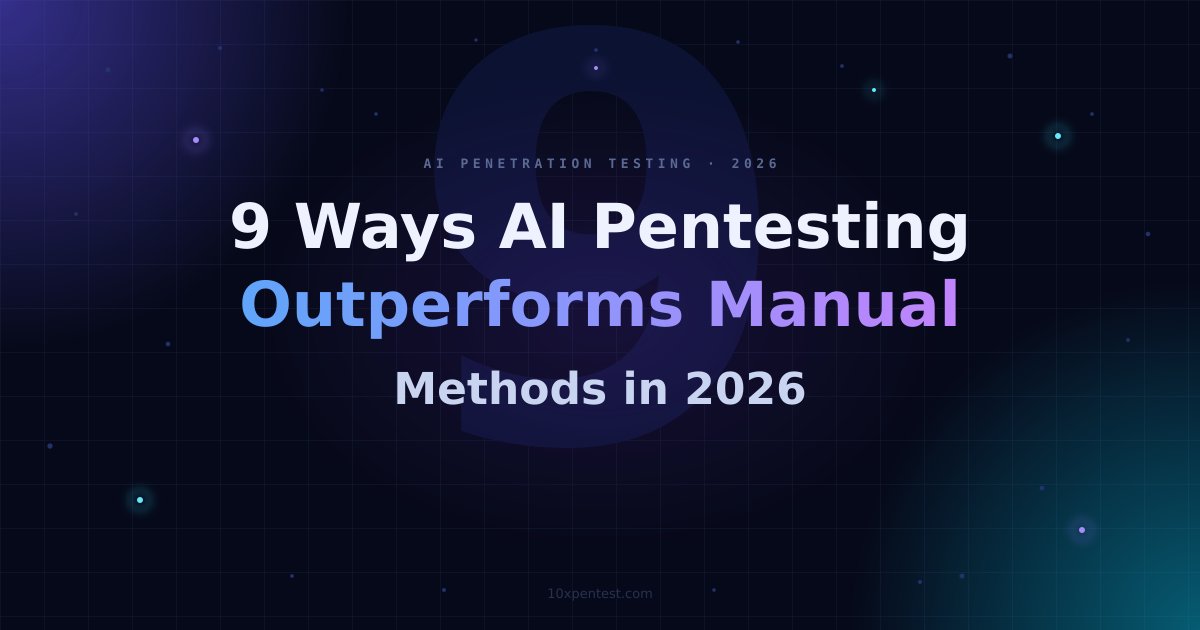
AI penetration testing, and specifically agentic AI pentesting built on systems that reason through attack paths rather than just match signatures, outperforms manual methods across nine measurable dimensions. Each one matters independently. Together they represent a qualitative shift in what security validation can look like at the pace modern software development demands.
1. Speed from setup to first finding
A traditional manual engagement runs from decision to first finding in roughly eight to twelve weeks when procurement, scheduling, scoping, and testing time are counted together. A week-long engagement produces an initial readout somewhere in week seven or eight at the earliest.
AI penetration testing eliminates the lead time entirely. Setup requires a target URL and a defined scope. Testing begins within minutes. Initial findings surface within hours. The difference between eight weeks and eight hours is not an incremental improvement. It is a different class of tool with a different operational model.
For security teams trying to validate before a major release, respond to a threat intelligence signal, or test a newly deployed service, the speed difference determines whether security testing is a gate or a retrospective.
2. Surface coverage on every run
Manual testers prioritize. They have to. Given a one or two-week engagement window and a large application surface, an experienced team makes explicit decisions about which components deserve the most attention and which will receive less or none. Those decisions are made by professionals and informed by good judgment, but they still mean portions of the surface go untested.
AI pentesting does not prioritize by time budget. Every endpoint in the defined scope is tested on every run. The 75+ specialized agents running in parallel on the 10x Pentest platform cover authentication, authorization, input validation, business logic, session management, and more simultaneously, without the sequential bottleneck that bounds a human team's coverage.
For enterprises with large API surfaces, microservices architectures, or rapidly expanding application portfolios, the coverage difference between a manual engagement and continuous agentic testing is the difference between a sample and a census.
3. Consistency without cognitive variance
Human performance varies. Even excellent pentesters have better and worse days, vary in focus across long engagements, bring different strengths to different vulnerability classes, and are affected by fatigue, distraction, and the accumulated cognitive load of a multi-week assessment.
AI systems do not. The same agent that tests authentication flows on day one of an engagement runs the same tests with the same thoroughness on day thirty. There is no engagement fatigue, no recency bias toward the last attack path explored, and no variance between how carefully an endpoint is tested at 9am versus 4pm on day eight.
This consistency matters most in the areas where human variance is highest: the systematic coverage of lower-priority endpoints, the thoroughness of parameter enumeration, and the completeness of test case coverage within a known vulnerability class. AI pentesting delivers the same standard across every endpoint on every run.
4. Parallel operation at scale
A manual pentest team operates largely in series. One tester works through an authentication flow while another enumerates API endpoints. The team's total output is bounded by the number of people, their hours, and the sequential nature of human work.
AI penetration testing is inherently parallel. At 10x Pentest, more than 75 specialized agents work simultaneously across distinct security domains. While authentication agents are testing token logic, authorization agents are mapping permission boundaries, input validation agents are probing injection surfaces, and business logic agents are tracing workflow paths. The parallelism is not just faster; it produces a more comprehensive view of the application than sequential testing can because agents share context across what they discover simultaneously.
For organizations with large surfaces or tight testing windows, this parallelism changes what is possible. A surface that would take a manual team weeks to cover fully is covered in hours.
5. Testing frequency that matches development cadence
A manual engagement is a point-in-time event. The report it produces describes the application as it existed during a specific testing window. Every change after that window, every deployment, dependency update, configuration change, and new feature, is unvalidated until the next engagement.
For teams shipping multiple times per week, the gap between a manual engagement and the next one represents weeks or months of unvalidated production code. Security teams hold reports that accurately describe application versions that no longer exist.
AI penetration testing runs continuously, triggering on deployment events and running against the updated surface before the next sprint begins. The continuous security validation model means security posture is always current rather than historical. In a threat environment where exploit windows have compressed to weeks, that currency is not optional.
6. Proven exploitability, not theoretical risk
The false positive problem in automated security tooling is well documented. Traditional scanners match responses against signature libraries and report findings that look like known vulnerabilities whether or not they are actually exploitable in the specific application context. Security teams learn to treat scanner output as a triage starting point, which means engineering time goes toward investigating maybes before fixing confirmed issues.
AI pentesting at the agentic level does not report theoretical risk. A SQL injection finding is not in the report until data is extracted. An authentication bypass is not reported until unauthorized access is demonstrated. An IDOR is not flagged until it is proven that user B can access user A's resource. The standard is proof, not probability.
This changes the operational relationship between the security team and the finding list. A list of twenty confirmed, exploitable vulnerabilities gets acted on immediately. A list of two hundred potential vulnerabilities gets triaged, filtered, and partially deprioritized. Proven findings drive faster remediation.
7. Automatic retesting after every fix
In a manual engagement model, confirming that a fix actually works requires scheduling a retest. That retest may be part of the original engagement scope, billed separately, or deferred to the next quarterly cycle. In each case, the fix sits unvalidated in production for days, weeks, or months.
This creates a gap between engineering's confidence that something is fixed and security's verified confirmation that it is. For organizations with remediation SLAs or audit requirements that include fix validation, that gap is a compliance and operational problem.
AI penetration testing retests automatically. When a fix is deployed, the system retests the specific finding the same day and confirms whether the vulnerability is genuinely resolved. The remediation loop closes continuously. Security teams have real-time validation that fixes are holding rather than periodic hope that they might be. As covered in the overview of autonomous pentesting, this continuous loop is one of the core architectural differences between agentic testing and everything that came before it.
8. Cost per vulnerability found
A manual enterprise penetration test runs $15,000 to $80,000 per engagement. For that investment, a skilled team covers a prioritized subset of the application surface over one to two weeks and produces a report documenting what they found. Cost scales linearly with scope.
AI penetration testing decouples cost from scope and frequency. The same platform that tests one application tests twenty applications without a proportional increase in spend. Running monthly instead of annually is not twenty times more expensive; it is a continuous model with a fixed cost structure. The cost per confirmed vulnerability found, when calculated across a year of continuous testing against a year of two manual engagements, consistently favors agentic testing by a significant margin.
For security leaders making the business case for expanded testing coverage, this economic structure is the argument. See 10x Pentest pricing to understand what continuous coverage costs at different application scales.
9. Intelligence that compounds over time
A manual engagement produces a report. Each engagement is a fresh start: new scope, new tester familiarity curve, new context-building phase before meaningful testing begins. The institutional knowledge from one engagement does not carry forward into the next.
Agentic AI systems improve as they accumulate findings across assessments. When an agent discovers a vulnerability pattern in one component of an application, that pattern informs how other components are tested. The system builds a progressively richer model of the application's behavior, which means later runs are not just faster but more targeted. Findings that require inference across multiple sessions become discoverable because the context carries forward.
For organizations running continuous agentic testing, this compounding intelligence means the system gets better at finding issues in their specific application the longer it runs. Manual engagements reset with every new engagement. AI pentesting compounds.
Where manual expertise still matters
Nine measurable advantages in favor of AI pentesting does not mean manual expertise is obsolete. There are specific scenarios where human judgment adds value that current agentic systems do not fully replicate: highly novel attack chains that require genuine creative leaps, deeply domain-specific business logic in specialized industries like financial services or healthcare where contextual expertise matters, and compliance frameworks that specifically require third-party human attestation by name.
The practical model for most security programs in 2026 is agentic testing as the continuous foundation, with targeted human review reserved for scenarios that genuinely require it. That allocation of human expertise produces better security outcomes than annual manual engagements because it focuses skilled judgment on the problems that actually need it.
For security teams ready to evaluate what AI penetration testing delivers in practice, the 10x Pentest platform is built around exploit-driven agentic testing across all nine dimensions above. Get in touch to discuss how continuous AI pentesting fits your stack, or explore pricing to understand what coverage looks like at your scale.
Frequently asked questions
1. Is AI penetration testing as accurate as manual testing?
For the majority of vulnerability classes, yes. Agentic AI systems match human accuracy on finding and proving exploitable issues while producing significantly fewer false positives than scanner-based tools. Where the difference remains is in highly novel attack chains and deeply domain-specific business logic, where senior human testers with specific industry expertise still have an edge. For the OWASP Top 10 and the broad vulnerability classes that affect most applications, agentic AI pentesting matches or exceeds manual accuracy, and does so at a speed and scale that manual testing cannot approach.
2. What does AI penetration testing actually do differently from a vulnerability scanner?
The distinction is fundamental. A vulnerability scanner matches observed conditions against a library of known-bad signatures and reports matches. It does not reason, adapt, or prove exploitability. An agentic AI penetration testing system makes real-time decisions about which attack paths to pursue based on what it discovers, adapts its approach when the target responds in unexpected ways, chains findings across components, and proves exploitability before reporting. The intelligence is in the reasoning, not the payload library. That reasoning is what enables agentic systems to find business logic flaws, chained attack paths, IDOR vulnerabilities, and race conditions that scanners structurally cannot reach.
3. How much faster is AI penetration testing compared to manual?
From setup to first finding: manual engagements take six to twelve weeks from decision to initial results when procurement, scheduling, and testing time are counted. AI penetration testing produces initial findings within hours of setup. For ongoing testing, manual teams test a subset of the surface over one to two weeks per engagement. Agentic systems cover the full defined scope in hours, continuously. The speed difference is not incremental. It is the difference between a periodic event and a continuous capability.
4. Can AI penetration testing replace annual compliance pentests?
For most compliance frameworks, yes. SOC 2, ISO 27001, PCI DSS, HIPAA, and GDPR all accept AI penetration testing output as security validation evidence. The continuous testing model produces an ongoing evidence record that increasingly satisfies auditor expectations better than a single annual report. Where a compliance framework specifically requires a human-led third-party assessment by name, that specific requirement must be met separately. For the majority of enterprise compliance programs, AI pentesting meets the requirement and produces more current evidence than the annual manual model.
5. How does AI penetration testing handle complex, authenticated application surfaces?
Agentic AI systems maintain full authenticated session state across multiple user roles simultaneously. They navigate role-based interfaces, map which functions are accessible to which permissions, and systematically test whether authorization boundaries between roles are enforced. This includes multi-step workflows, stateful transaction flows, and permission transitions that change what a session can access based on prior actions. Manual testers use similar methodologies; the difference is that agentic systems apply this coverage to the full defined scope on every run, rather than to a prioritized subset during a bounded engagement window.


 Tejas Dhokane Oct 22, 2026